To make it 10 years in a world that always feels hungry for the next big thing is no small feat. Chef’s Table, then, has much to celebrate as it enters its second decade of documenting the most interesting, innovative, and out-of-this-world chefs from all over the globe. Over the course of its lifetime, the docuseries has become the gold standard in foodie entertainment with hour-long, exhaustively detailed and sumptuously shot episodes about the culinary world’s brightest stars, including Massimo Bottura, Dominique Crenn, Francis Mallmann, Mashama Bailey, Evan Funke, and Asma Khan, to name a few.
Created by Jiro Dreams of Sushi documentarian David Gelb, Chef’s Table is an immersive experience that involves the show’s crew spending weeks with their subjects to get a close, inside look at the detailed workings of their kitchens. Think of it as the “slow food” of cooking shows, concerned with quality and care over quantity and convenience. Scroll through the many seasons — as well as spin-offs like Chef’s Table: Pizza and Chef’s Table: France — and you immediately understand why the series has been so successful. It’s not so different from the restaurants on the screen: If you make something consistently hearty and delicious, with tenderness and technique, customers will keep coming back. “We really want to open up the world to our viewers,” explains Gelb, of the mission of the series. “We discovered that, as long as the chef is passionate and cares deeply about what they’re doing, it can work. And we’re very fortunate that we get to continue to do it.”
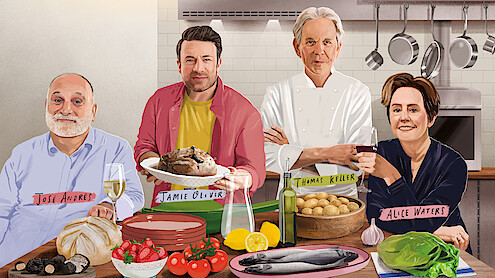
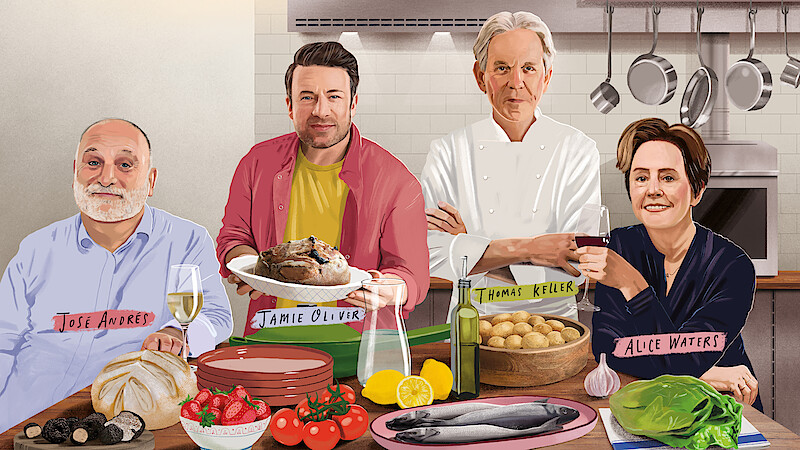
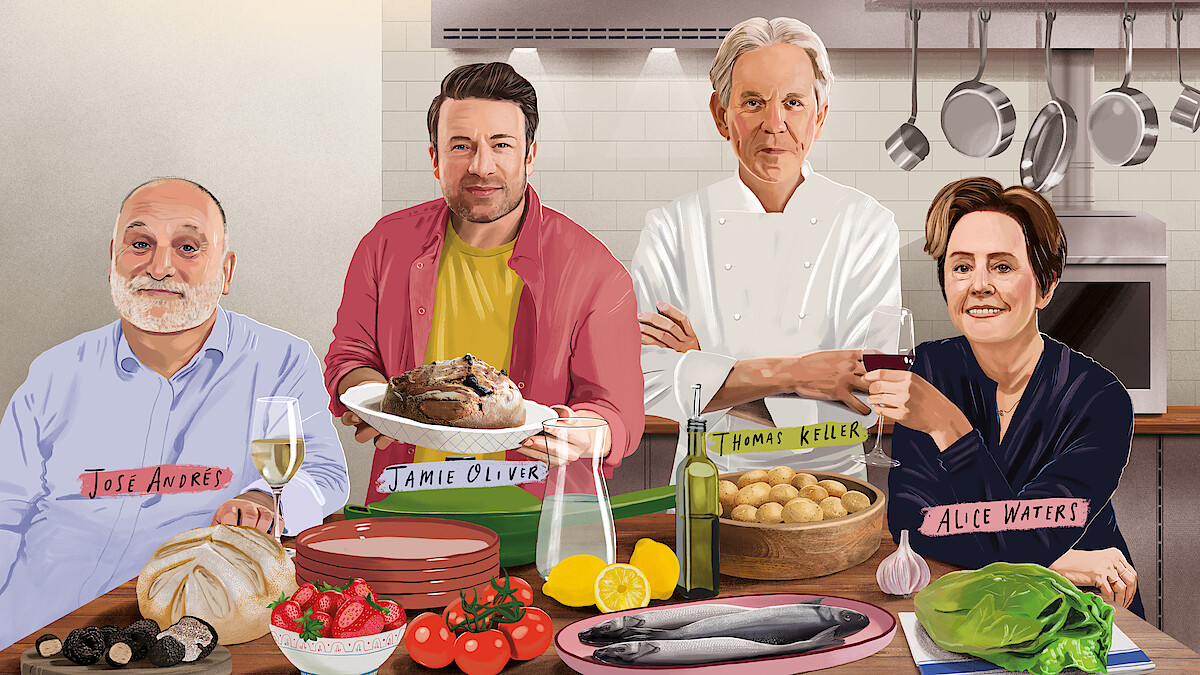
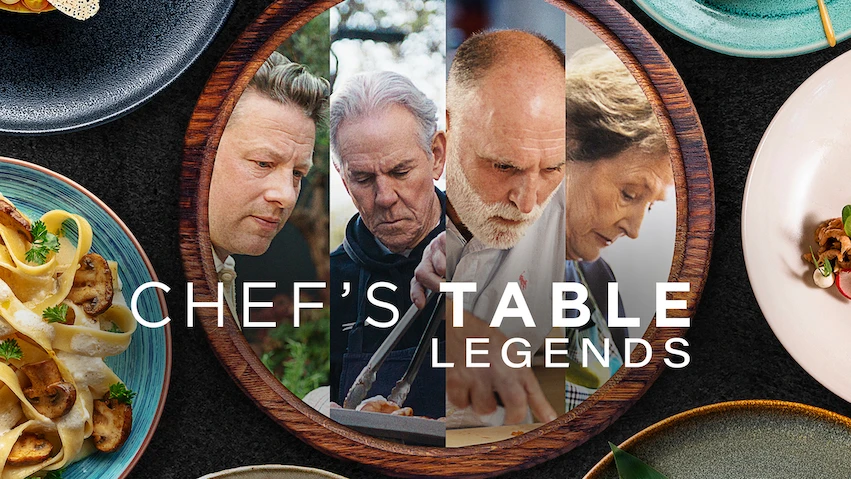
To commemorate 10 years, the documentary series is now offering up Chef’s Table: Legends, which brings the franchise’s signature storytelling to four icons of the culinary world: Jamie Oliver, José Andrés, Thomas Keller, and Alice Waters. We asked these towering figures, as well the show’s creators, why food holds such a special place in our hearts.
How did you choose these four chefs as the legends?
David Gelb, creator and executive producer: The baseline for every chef that we’ve ever done is passion. It’s all about fully committing themselves to what they’re doing, be it their craft, be it their message. And then we take the journey that their passion takes them on, and their ups and downs, and they go in the wrong direction, and they correct it. And that leads us to an amazing story.
Andrew Fried, executive producer: Alice’s vision with local, sustainable food is revolutionary. Thomas Keller’s mastery continues to set the bar for excellence. Jamie makes food accessible in ways that touch millions of lives, and José — his heart and generosity have an impact far beyond kitchens. They’re legends because they each shift the culinary landscape in their own way.
Why do cooks cook?
Thomas Keller: What made me a cook, and the reason I am in this profession, is because my mentor chef Roland Henin asked me that very question in 1977 in Narragansett, Rhode Island at the Dunes Club, to be exact. It was a July day. We were chatting, and towards the end of the conversation he just asked me, “Do you know why cooks cook?” I was barely 21 and nothing was on my radar about becoming a professional chef. At that time, I was just cooking because I did it well. It afforded me the ability to travel, and I enjoyed it. I enjoyed the teamwork. I didn’t really have an answer. And he said: “We cook to nurture people.” And those few words changed my life.
Jamie Oliver: When I started school, I had undiagnosed dyslexia. I really struggled. I struggled reading. I struggled writing. I had loads of ideas and creativity, but I couldn’t get them on paper. Cooking was something that allowed me to express myself and have value. At the weekends, I would earn pocket money by cooking. Fast-forward a couple of years, I was working next to 20- and 30-year-old men and women and doing a job, running a section, and getting paid for it as a teenager. Monday to Friday, things continued to be pretty shit. And then at the weekends, things were amazing, and it was a beautiful world, and it was dynamic and it was creative and it was delicious. It felt like freedom and independence. And when I say cooking saved me, I don’t think I’m exaggerating.
What is one thing you wish people understood about food?
Gelb: We all wanted to give the audience a perspective on what food can be, and the passion that goes into making something delicious. Because it’s actually the story that makes it taste even better. That’s why you remember it. It’s the emotional context.
Alice Waters: Where it comes from, when it’s in season, how it was grown, and whether the people who are growing it are making a good living by doing so. How are they taking care of their farmworkers? How are they taking care of the land? It’s all of a piece for me. I love it when I know my farmer.
Buy local, organic, regenerative food. Because we did that before World War II, before fast food. That was a time when we were asked to plant gardens, so the food could be shipped to the soldiers. And it was before any kind of poisons were put into the soil. I have memories of my parents’ victory garden. I mean, when the strawberries were there — wow. And tomatoes — I don’t think I’ve ever eaten a tomato as good as that. And I was very lucky to have that, to have that still to this day, the taste-memory from my parents’ garden. And they kept their victory garden until they died.
Keller: The amount of effort, the amount of work, the amount of commitment that people make in their lives to bring other people joy. If you go back to the farmers, fishermen, gardeners who are the bedrock of what we do, without them, we would be nothing. We have to appreciate the commitment they make. Just think of Diane St. Clair — she’s retired now, but she had four cows, and from them supplied me butter. Here’s a woman who woke up at 4 a.m. in the morning every single day, seven days a week, to milk her cows. And then before she went to bed at night, she had to milk them again. That’s not a five-day-a-week job. And that’s just to bring an ingredient right to you, something that you may not even think about: taking a piece of butter and putting it on some bread. But this is a woman who’s contributed a large part of her life to raising animals in the proper way, and making a beautiful butter that, now, I am able to share with you.
José Andrés: When I say food can be the solution, I mean that at a very deep level. It’s a cultural thing, something that defines who we are. It’s part of our DNA. Every culture is so proud of its dishes. There have been wars to control food sources in the history of humanity. There have been impossible ventures to try to discover new routes for spices that helped different communities around the world make contact for the first time, like when Columbus arrived in the Caribbean and Latin America. The history of mankind is always explained through wars, but we could explain the history of humanity through food.
Oliver: I think, now more than ever, cooking is freedom. Cooking is the amazing ability to nourish yourself and your family and the people that you love with deliciousness and truth. And it’s a real superpower. If I had one wish in the world, it would be that every 16-year-old kid would leave high school knowing 10 recipes to save their life, the basics of nutrition, where food comes from, and how it affects their body. It is not a luxury; it’s a necessity. It’s a life skill. Every time you’re trying to fix a problem, you’re looking at the most vulnerable within the problem. And in the UK, we have free-school-lunch kids, and the parents of those kids have to be earning a very small amount of money to get that free school lunch. Filling that child's tummy and that child's mind is really exciting.
For me, that just gives you a template for true hope. And to truly be fair, to truly be a democracy, you have to have hope — that no matter where you come from, as long as you apply yourself, as long as you turn up, as long as you’re kind, the sky’s the limit.
How can food change the world?
Andrés: Puerto Rico had among one of the worst hurricanes in modern history [Hurricane Maria, 2017] — an entire island without electricity, without hope. But we always know that there are people willing to help. There is always somewhere with food available. There’s always someone with a generator or gas. There is always somewhere you can start cooking. When I landed two or three days after the hurricane, we began cooking, and we made two thousand meals. Then we just didn’t stop growing until we reached eight hundred and fifty thousand meals. We opened more than 36 kitchens. We showed that we all need to pitch in. At the end of the day, with these emergencies, I learned that you need the federal government, you need the local governors, you need the National Guard, but also that civil society becomes part of the response.
What has made Chef’s Table so singular in the world of food entertainment?
Gelb: It wasn’t about wanting to be different, it was about making a thing that I really wanted to see. It’s an inspiring chef telling their life story — and making it about more than just food. It’s not about how they cook, it’s about why. That’s the real heart of it. And that’s what makes us different from a “normal” show.
Fried: That universal connectivity is what has kept it fresh and relevant.
Adam Bricker, cinematographer: We came to it with a fresh perspective, thinking about it more like, “How can we show the hero’s journey of these chefs and just give them all the cinematic, filmic treatment that their stories deserve?”
What’s one ingredient that you absolutely could not live without?
Waters: Well, I’d say salad, but salad has to have garlic. I couldn’t live without garlic. As the Chinese say, garlic is as good as 10 mothers. But olive oil comes a close second. And just lettuces — that was what I first needed to have. I planted lettuces in my backyard to grow for Chez Panisse.
Oliver: Olive oil. We grew up using butter and lard and ghee. But olive oil is the connector. It’s the thing that allows you to transmit flavor and spice and herbs. And of course, it’s the healthiest oil on the planet, full of polyphenols.
Keller: Salt. The other one would be acid. Those are the only two ingredients that elevate flavor. Everything else changes flavor. If you taste puréed potatoes and it’s bland, you know it needs salt. And then when you add salt to it, you go, “Oh my God.” It elevates that flavor profile so much that you’re captivated by it.
Andrés: Love. Because if you have ingredients and you don’t use them with love, they’ll never be good.
This interview has been edited and condensed for clarity.
A version of this story appears in Queue Issue 20.